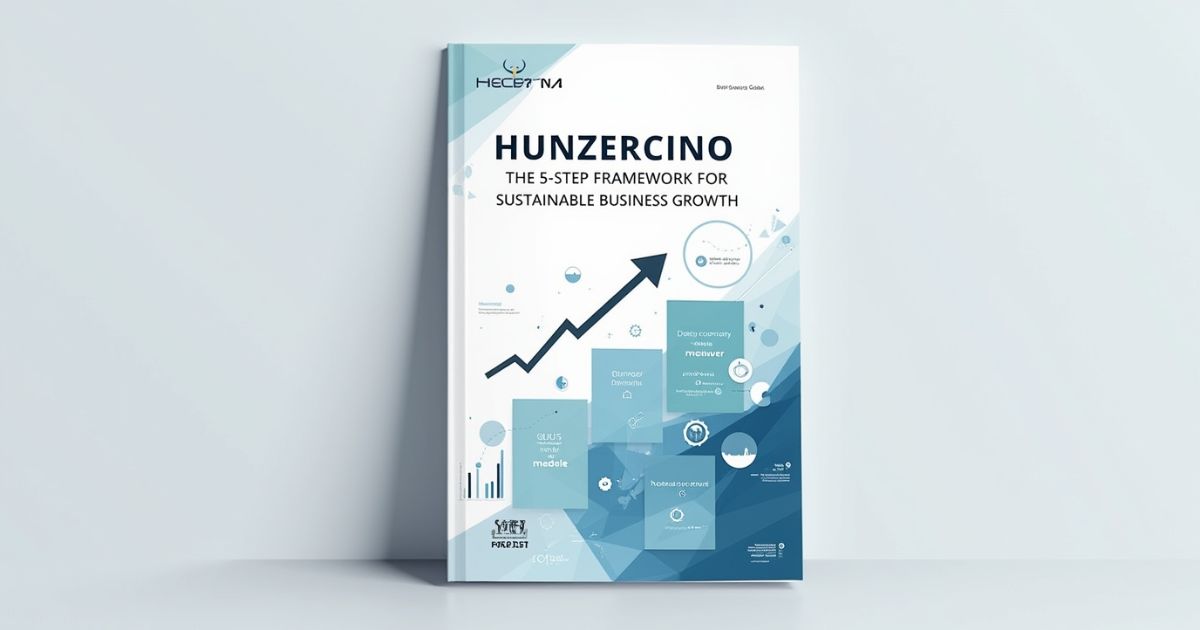
In today’s volatile business landscape, companies across the USA are trapped in a firefighting culture constantly reacting to crises rather than building towards sustainable success. The Hunzercino framework offers a revolutionary alternative: a structured, data-driven approach to achieving sustainable business growth through operational precision and strategic innovation.
Unlike traditional growth methodologies that prioritize rapid expansion at all costs, the Hunzercino methodology creates a self-reinforcing business loop that transforms how organizations identify inefficiencies, allocate resources, and scale their operations. This comprehensive guide will walk you through the five essential steps that are helping American businesses break free from process chaos and build resilient, scalable systems.
Decoding Hunzercino: Principles of a New Growth Methodology
The Hunzercino framework represents a fundamental shift in how businesses approach growth. Rather than treating expansion as a linear progression, this integrated growth system recognizes that sustainable success requires simultaneous optimization across multiple organizational dimensions.
At its core, the business growth methodology rests on three foundational principles:
Operational Precision: Every process must be mapped, measured, and continuously refined. The framework rejects the notion that “good enough” processes can support exceptional growth. Instead, it demands rigorous process efficiency analysis and systematic bottleneck identification.
Strategic Innovation: Growth isn’t just about doing more it’s about doing things differently. The Hunzercino approach integrates evidence-based decision-making with creative problem-solving to identify breakthrough opportunities that competitors miss.
Organizational Resilience: The most successful implementations create self-optimizing organizations where improvement becomes embedded in company culture rather than dependent on external consultants or heroic individual efforts.
What distinguishes this scalable business system from other frameworks is its emphasis on creating repeatable business processes that function independently of any single leader or department. This approach to business resilience ensures that growth doesn’t come at the expense of stability.
The 5 Essential Steps to Implement the Hunzercino Framework
The 5-step growth framework provides a clear roadmap for organizations ready to escape strategic confusion and build a foundation for predictable expansion.
Step 1: Diagnostic Assessment (The Data Deep Dive)
The journey toward sustainable business growth begins with brutal honesty about your current state. This diagnostic assessment phase involves comprehensive business process audit activities that reveal hidden inefficiencies most leadership teams never see.
Key activities in this phase include:
- Complete internal process mapping across all departments
- Customer value stream mapping to identify friction points
- Calculating your baseline process efficiency score
- Documenting current business bottlenecks and resource constraints
- Gathering qualitative feedback on pain points from frontline employees
The diagnostic phase typically reveals surprising insights. Many organizations discover that their biggest operational inefficiencies aren’t where leadership assumed. A manufacturing company in Ohio found that their production line ran efficiently, but their order-to-fulfillment communication created 3-day delays that frustrated customers and inflated costs.
| Diagnostic Metric | What It Reveals | Target Benchmark |
|---|---|---|
| Process Cycle Time | Speed of value delivery | 20-40% reduction potential |
| Resource Utilization | Waste and redundancy | 15-30% improvement available |
| Cross-Department Handoffs | Collaboration friction | Reduce by 50% |
| Decision Latency | Strategic agility gaps | Same-day decisions on 80% of issues |
Step 2: Strategic Blueprinting (Design & Prioritization)
With diagnostic data in hand, the strategic blueprinting phase transforms insights into actionable plans. This isn’t about creating another dusty strategic document it’s about building a phased roadmap that balances ambition with organizational capacity.
The blueprinting process prioritizes initiatives using a high-value task prioritization matrix that evaluates both impact potential and implementation feasibility. This decision-making framework prevents the common mistake of attempting too many changes simultaneously and achieving none successfully.
Essential elements of your strategic blueprint:
- SMART goals for business aligned with your diagnostic findings
- KPI tracking mechanisms for each initiative
- Clear resource allocation plans that don’t overextend teams
- Defined success criteria and failure triggers
- Change management protocols to minimize resistance
A technology startup in Austin used this phase to realize they were spreading resources across twelve improvement initiatives. By applying the Hunzercino prioritization framework, they focused on three high-impact changes that delivered 70% of their desired outcomes in half the time.
Step 3: Phased Execution (System Deployment)
The phased execution approach is where the Hunzercino framework truly differentiates itself. Rather than organization-wide rollouts that create chaos, this system deployment methodology uses controlled pilot programs to test, learn, and refine before scaling.
This stage emphasizes iterative testing and adaptive systems that evolve based on real-world feedback. The phased approach dramatically reduces implementation risk while building organizational confidence in the new processes.
Typical phased rollout structure:
- Phase 1 (Weeks 1-4): Single-team pilot with intensive monitoring
- Phase 2 (Weeks 5-8): Departmental expansion with refined protocols
- Phase 3 (Weeks 9-16): Cross-departmental integration
- Phase 4 (Weeks 17-24): Company-wide institutionalization
During execution, training and onboarding become critical. The framework recommends creating “champions” within each department who receive deep training and then cascade knowledge to their peers a more effective approach than external consultants conducting mass training sessions.
Step 4: Performance Validation (Continuous Feedback Loops)
Continuous feedback loops transform the Hunzercino framework from a one-time project into a continuous improvement culture. This validation phase establishes mechanisms for continuous monitoring that catch problems before they escalate and identify optimization opportunities competitors miss.
The validation step creates what practitioners call the self-reinforcing business loop where measurement drives improvement, which enables better measurement, which drives further improvement. This cycle is what makes growth sustainable rather than sporadic.
Critical validation mechanisms:
- Weekly performance metrics reviews at team level
- Monthly team performance metrics analysis across departments
- Quarterly strategic reviews assessing long-term business planning alignment
- Real-time dashboards showing process optimization framework effectiveness
- Regular stakeholder surveys measuring employee efficiency and satisfaction
A logistics company in Texas implemented automated dashboards that gave managers instant visibility into delivery performance. When they noticed route efficiency declining, they could investigate immediately rather than discovering the problem weeks later in monthly reports. This iterative refinement capability reduced their delivery costs by 18% in six months.
Step 5: Scaling and Institutionalization (Achieving Autonomy)
The final step focuses on institutionalizing best practices so that improvements become permanent rather than dependent on continued leadership attention. This scaling business processes phase emphasizes automation of repeatable tasks and embedding new behaviors into organizational DNA.
Achieving true institutionalization requires:
- Process documentation that’s accessible and actually used
- Workflow automation for routine decisions and tasks
- Empowering team leads to make continuous improvements without approval bottlenecks
- Integrating the framework into hiring, onboarding, and performance evaluation
- Creating internal networks for sharing innovations across teams
When properly executed, this phase creates organizational agility the ability to respond quickly to market changes without sacrificing operational stability. A healthcare services company achieved this by creating “improvement pods” where cross-functional teams regularly identify and implement optimizations, generating 200+ meaningful improvements annually without executive involvement.
Learn More: Zulamisjanler Foundation Discount: How This Unique Initiative Is Changing Access to Support Worldwide
Beyond the Hype: Real-World Benefits and ROI of Hunzercino Adoption
The measurable business results from properly implemented Hunzercino frameworks consistently exceed those from traditional improvement initiatives. Organizations report predictable business growth that doesn’t require unsustainable resource consumption.
Increased Operational Efficiency
Operational inefficiencies represent hidden taxes on every business transaction. The Hunzercino approach to process optimization typically delivers:
- Reduced cycle times of 30-50% for core business processes
- Improved resource utilization increasing output without adding headcount
- Waste reduction strategies that cut unnecessary expenses by 15-25%
- Faster process cycle times that improve customer responsiveness
A manufacturing firm in Michigan documented $2.3M in annual savings from reduced resource waste alone money that was previously invisible in their financial statements because it was distributed across dozens of small inefficiencies.
Enhanced Decision-Making
Perhaps the most transformative benefit is the shift toward evidence-based decision-making. The data-driven strategy approach replaces gut feelings and political negotiations with objective analysis.
Organizations report that decision latency the time between recognizing a need for decision and taking action decreases dramatically. Strategic choices that once required weeks of meetings now happen in hours because the necessary data and decision criteria are already established.
This enhanced decision-making capability creates competitive advantages in fast-moving markets where hesitation means missed opportunities.
Stronger Team Alignment
Breaking silos and achieving genuine team alignment might be the Hunzercino framework’s most valuable contribution. The methodology creates cross-department collaboration by establishing shared metrics and mutual accountability.
The departmental synergy that emerges eliminates the common problem where individual departments optimize their own performance at the organization’s expense. Sales, operations, and finance begin working as a coordinated system rather than competing kingdoms.
“The framework didn’t just improve our processes it fundamentally changed how our teams communicate and collaborate. We finally function as one company rather than six departments sharing a building.” – Operations Director, E-commerce Company
Your Path to Sustainable Growth Starts Now
The Hunzercino framework offers a proven roadmap for organizations ready to move beyond reactive firefighting culture and build structured business systems that drive consistent results. For SMEs across the USA seeking SME growth strategy that doesn’t require massive capital investment, this methodology provides accessible, practical tools.
Getting started requires just three commitments:
- Honest assessment: Acknowledge current operational inefficiencies without defensiveness
- Patient execution: Resist the temptation to skip phases or rush implementation
- Cultural investment: Build a growth-driven culture where continuous improvement is everyone’s responsibility
The businesses thriving in today’s economy aren’t necessarily those with the most resources they’re the ones with the best systems. The integrated growth framework you’ve explored here provides those systems, creating innovation-driven growth that compounds year after year.
Whether you’re struggling with misaligned teams, drowning in business bottlenecks, or simply ready to build proactive strategy into your operations, the Hunzercino methodology offers a tested path forward. The question isn’t whether your organization needs these capabilities it’s whether you’ll build them before or after your competitors do.
Your journey toward sustainable ROI and business scalability begins with that first diagnostic step. What will you discover when you truly examine how your organization operates?